

What exactly is a dispersant? Do you understand its mechanism of action and value to the industry?
Release Time:
2026-03-26

Dispersants are a class of surfactants possessing both lipophilic and hydrophilic properties. Their core function is to improve the dispersion of solid or liquid particles within a medium, preventing particle agglomeration and sedimentation to form stable, uniform suspensions. They are indispensable key additives in the production of fine chemicals, coatings, inks and other industries. Their applications span multiple sectors; from the simple colour matching of everyday paints to the processing of raw materials in industrial production, dispersants provide essential support, acting as a vital link between raw materials and finished products.
The fundamental mechanism of dispersants is to alter the physicochemical properties at the particle interface, establishing a repulsive barrier between particles to inhibit agglomeration at its source. There are two primary mechanisms of action: the electrostatic repulsion mechanism, which involves adsorbing ions onto the particle surface to impart the same charge to the particles, causing them to repel one another and disperse; and the steric hindrance mechanism, which forms a polymer protective film on the particle surface to prevent particles from coming into close proximity, offering greater adaptability.
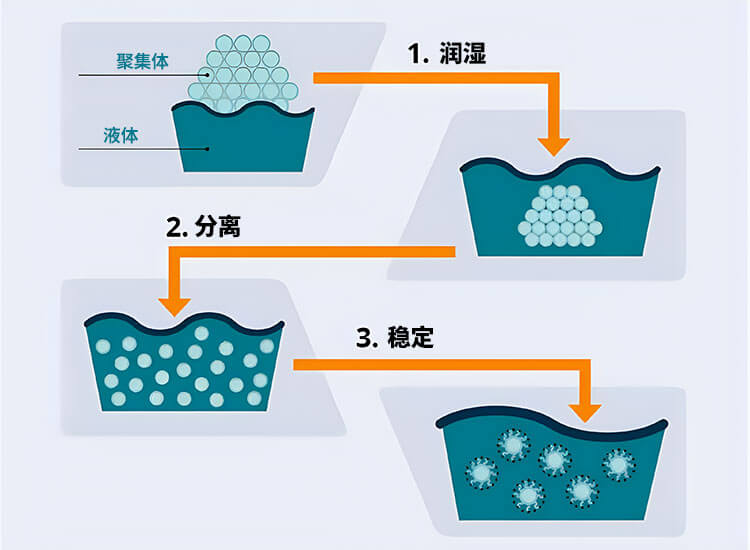
Compared to systems without dispersants, the addition of dispersants offers multiple advantages: it shortens particle dispersion time and improves production efficiency; improving system stability to prevent product separation and sedimentation; optimising product appearance, such as the gloss and colour uniformity of coatings; reducing system viscosity to facilitate application and transport; and increasing the loading capacity of pigments and other fillers, thereby lowering production costs. As the industry evolves, dispersants are moving towards greater environmental sustainability and higher efficiency; low-VOC and phosphate-free dispersants have become the market mainstream, helping various industries achieve green production.


Related News
What do you want?
If you have any questions about our products, please leave your email to us and we will contact you within 24 hours.

Haier Road, Yanjialing Industrial Park, Tongji Office, Qingdao, Shandong, China
Products
Follow us

Website QR Code